Happy Halloween! This is one of my favorite holidays! I recently did a deep dive into the history and origins of Halloween, and I want to share that information because I feel it’s mostly unknown. This means it’s time for another history lesson!
Halloween started as the Celtic new year festival called Samhain (Saw-win) in the British Isles- what is today England, Scotland, and Ireland. The start of their year was November 1st. This was also the day they believed that the spirits of the dead were closest to the land of the living. To ring in the new year, the Celtic people would extinguish the fires in their homes. They would dress in costumes and have a large bonfire as a whole community. It is believed that the costumes were disguises to avoid detection by the spirits. The spirits or ghosts were troublemakers. They damaged crops, played pranks, and would go into houses. However, they were also useful in that they could help the Druids (Celtic priests) predict the future. It was believed that the people would dress in costume and leave food outside of their house to blend in with and appease the spirits of the dead. After the celebration, the people would take some fire from the sacred bonfire and use it to light the fires in their home to keep them warm through the winter.
The Roman Empire tried to conquer what they knew of the world, and they made it all the way north from modern-day Italy to the Celtic lands. The holiday and celebration of Samhain became adapted with two Roman celebrations. The first was Feralia, which was a day to honor the deceased. The second was a feast day for the goddess Pomona. Pomona was the goddess of the harvest, and her symbol was an apple. (That may be where we get the idea of bobbing for apples).
Then comes Christianity. As the idea of Christianity spread, holidays and celebrations also adapted. These lands that had been Celtic and then taken over by the Roman Empire became Christian. At this time, the only branch of Christianity was Catholicism. In May of the year 609, Pope Boniface IV created a day to honor all the martyrs who suffered for Christianity. Later, Pope Gregory III moved the day from May to November and expanded the day to honor all saints of the Catholic church and the martyrs (many of whom were saints anyway). He called this day All Saints’ Day. However, the Middle English term at the time was Hallowmesse, and the term for the day before became All Hallow’s Eve. We still use the term Eve when we talk about Christmas and the day before Christmas Eve. All Hallow’s Eve then became Hallow Even, which was shortened to Hallowe’en until it lost the apostrophe and became the term Halloween.
The Catholic church believes in Purgatory, or the space between heaven and hell. In the Middle Ages, they sold indulgences, which was the idea that someone could lessen their time in Purgatory. However, it became corrupt and became a source of revenue for the Church. On October 31, 1517, Martin Luther, a priest and scholar at Wittenberg University posted ninety-five things that he disagreed with in the terms of indulgences to the church door. This was common practice for debate topics among the educated. However, instead of this sparking a debate, this sparked outrage. Within four years of the posting, Martin Luther was deemed a heretic. Other people joined in, and Christianity branched off into Catholic and Protestant. Further divisions also occurred, but this is Halloween origins, not a Christianity lesson.
Protestantism spread to much of western Europe, including England. King Henry VIII broke further from the Catholic Church and established the Anglican church. The Protestants were not treated the same way as the Catholics or the Anglicans in England, and they began to hope for a better life. They first traveled to Holland because of the religious freedom practiced there. However, they felt there was too much freedom and that it would be a bad influence on their children. So they chartered a boat to take them across the Atlantic Ocean to North America. Protestants do not believe in the saints the same way that Catholics do, and All Saints’ Day (and Hallowe’en) were not celebrated in the northern American colonies.
Over time, as more Catholic and Irish immigrants came to America, they brought their celebrations with them. As we saw with the Romans, the holiday adapted to the cultures. The celebration of Samhain merged with a Native American celebration ideas like celebrating the harvest as a community, telling stories of the dead, and dressing in costumes. The holiday continued to grow in popularity, especially as more Irish immigrants came over to the United States due to the potato famine that struck in the 1840s and 1850s.
It was around this time as well that Halloween transitioned from being about the spirits and the dead being close to the land of the living to a community-based celebration. Autumnal or harvest celebrations were town-wide events held in the center of town. By the 1920s and 30s, most of the supernatural elements of Halloween had been removed. After World War II, there was a surplus of babies being born, and it created a boom in the population (hence why the generation of people born after WWII were/are called baby boomers). Because of this, Halloween shifted once again to focus on the family and the school. It was made more child-friendly. Recently, we have seen the resurgence of some of the symbols of what Halloween used to be, such as ghosts and skeletons.
Halloween Traditions and Symbols Origins
Now that you know the history of Halloween, I also want to share a couple of traditions and symbols and their origins as well.
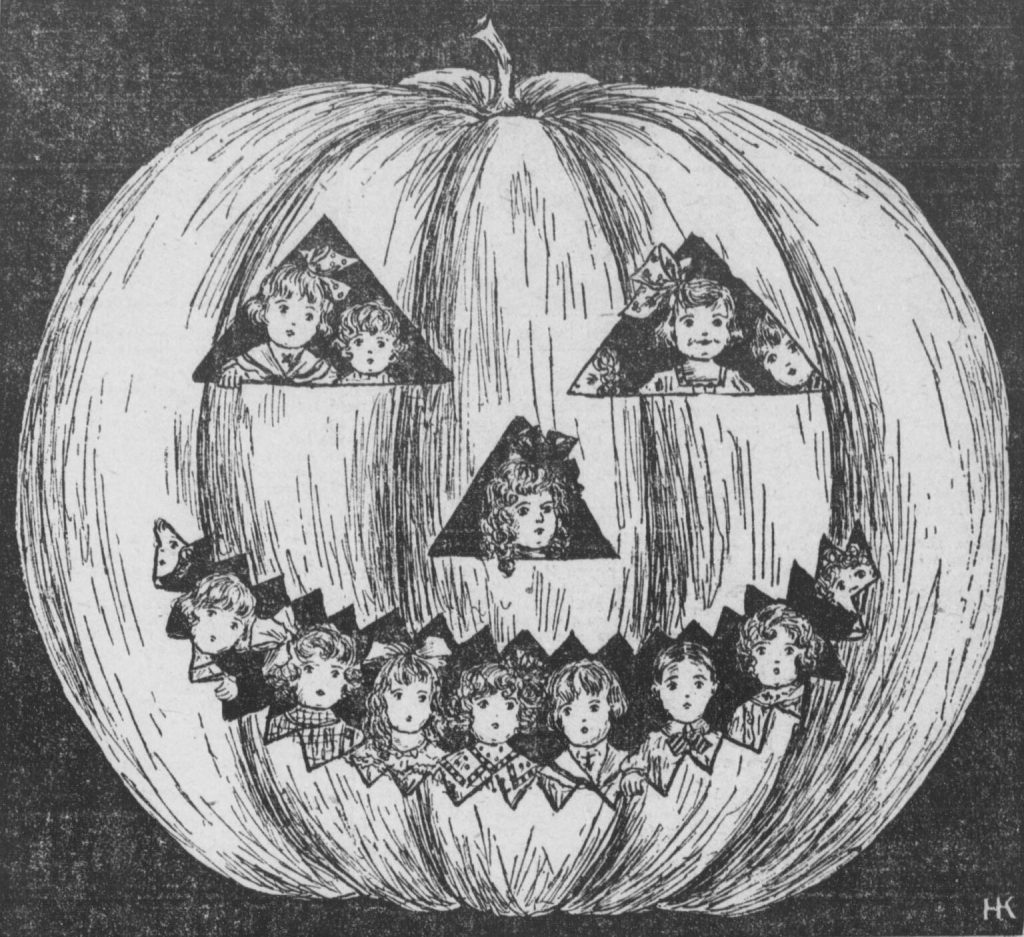
First up is the idea of carving jack-o-lanterns or pumpkins. The original vessels were turnips. The story goes there was a man named Stingy Jack. He trapped the Devil and made a deal with him that his soul would not be sent to hell when he died. The Devil agreed. However, it turns out that Heaven didn’t want him either. As a result, his spirit was left to wander the earth. To help him light his way, the Devil gave him some everlasting coal and fire to light his way and placed it in a turnip to not burn him. People then began to carve faces in turnips of their own to frighten evil spirits. As immigrants moved to America, pumpkins were easier to carve and more available than turnips.
Next is the idea of trick-or-treating. There are multiple theories as to how this got started. The first is that Celtic people left food to appease the wandering spirits so they wouldn’t break into the house. The second theory is the idea of “guising”. Children and poor adults would collect food and money for local shelters and homes in return for prayers for the dead. The children would also then perform songs, poems, stories, or other “tricks” as well. The third theory is the idea of “belsnickeling” which was actually a German tradition. Children would dress up in disguises and would then go to other adults and see if the adults could figure out who was under the disguise. Any child who fooled an adult received a treat. Trick-or-treating was revived in America in the 1900s. It was a way for the entire community to be involved in the celebration without having to go to the town center. Also, vandalism was an issue for people in the celebrations. So by providing treats or leaving them outside of the house, it could reduce the acts of vandalism.
Halloween Symbols
Black cats are a common symbol of Halloween. Black was the color of the Devil in the Middle Ages. It was believed that black cats were a supernatural creature that assisted witches with their magic. Today, we call this a familiar. The other idea is that witches themselves could turn into black cats. The Middle Ages were a time filled with superstition and that most things out of the ordinary were bad, and black cats fell into this.
The other symbol of Halloween I want to mention is the ghost. Many rituals and celebrations of this end of October time recognize that this is the time of year when the spirits of the dead are the closest to the land of the living. Ghosts are not necessarily a bad thing but serve as a reminder to the past.
Día de los Muertos
The Day of the Dead is a Mexican celebration that occurs on November 1 (and sometimes more days). The Nahua and Aztec people who lived in the land known as Mexico had ceremonies and rituals to honor their deceased and help guide them on their journey to the afterlife. Eventually, Spain (a Catholic country) took over that land and introduced their holidays and celebrations, including All Hallows Day and Hallowe’en.
Skulls were used to decorate the Aztec and Nahua places, but the use of the skull in Day of the Dead did not take off until much later. In the 20th century, political cartoons and commentary featured skulls and skeletons mocking prominent political figures. Jose Guadalupe Posada created a print that featured a woman’s skeleton in a fancy dress. His message was that some women were trying to deny their cultural background and become whiter, but in the end they will just become a deformed skull. The skeleton took off and became the symbol of Día de los Muertos. Today, Día de los Muertos celebrations remind us that we will all die one day. However, no one is truly gone unless they are forgotten.
I hope you enjoyed this week’s history lesson. I got to do this as a presentation for some of my students last week, and I learned a lot in the process. I hope you did as well. Halloween is fascinating to study, and I think it’s neat how its impact can be seen all over. Have a safe and happy Halloween, harvest celebration, Samhain, All Saints’ Day, Día de los Muertos, or anything else you celebrate as we close out October and transition to November!
Sources:
https://www.loc.gov/rr/european/luther.html
https://www.dictionary.com/e/jack-o-lantern-name/
https://www.history.com/topics/halloween/history-of-halloween
https://blogs.loc.gov/headlinesandheroes/2021/10/the-origins-of-halloween-traditions/#:~:text=Yet%2C%20the%20Halloween%20holiday%20has,costumes%20to%20ward%20off%20ghosts
https://www.history.com/topics/halloween/day-of-the-dead
https://www.history.com/news/day-dead-dia-de-muertos-origins
 Battle Kim of the Republic