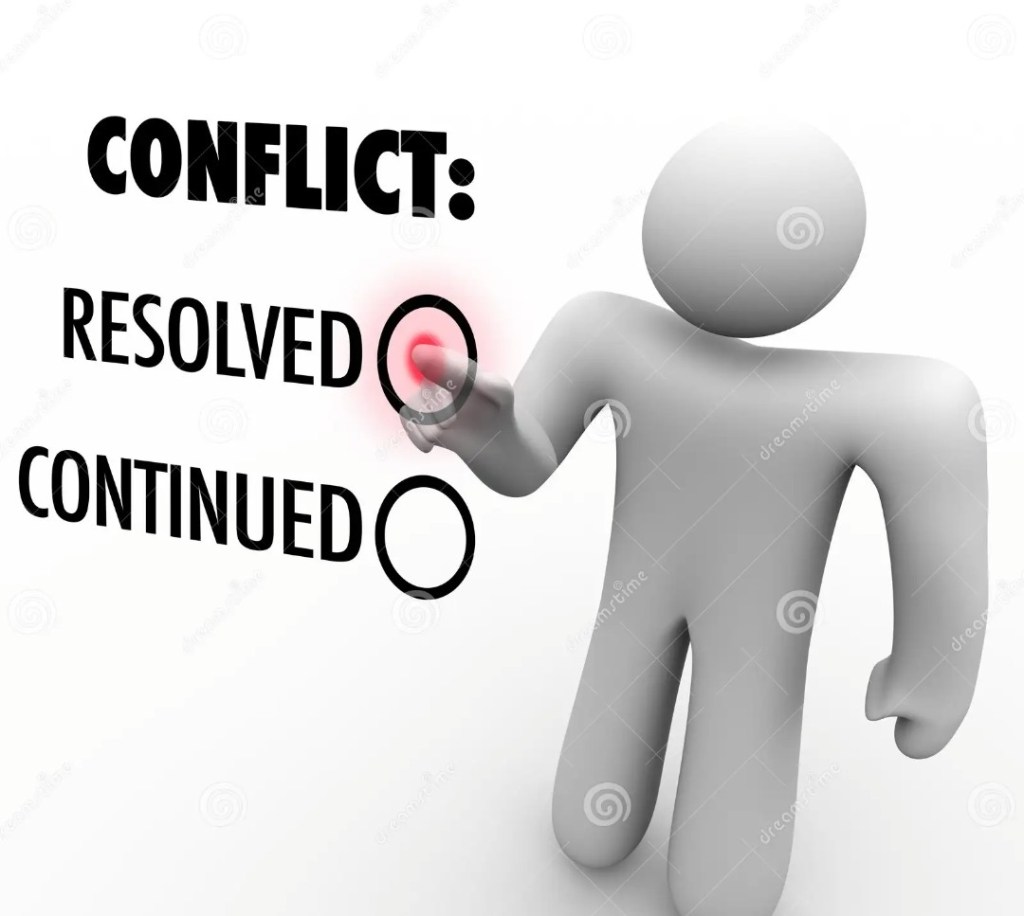
Conflict is something that happens to all of us, whether we want it to or not. At some point in time, you’re going to disagree with another person. Your views will not ever be the exact same as someone else’s all of the time.
How do you handle that conflict? Do you blow up, and make the issue worse? Do you draw into yourself and think negatively about who you are as a person? Do you handle it responsibly and effectively? There’s no judgment either way, but its definitely something to think about.
I run into conflicts with people I care about. I mess up, I put my foot in my mouth, and I say or do something dumb.
I hope that over time, I’ve been able to resolve conflicts peacefully, but I know that’s not always the case. I want to share with you (and remember for myself) some of the tips and tricks I’ve picked up on how to resolve issues peaceably in the hopes that someone will find these useful. While I may give examples pertaining to romantic relationships, these tips should work for all relationships.
- Give yourself time to cool off- I definitely have been a person who wants to resolve conflicts immediately. And while that works sometimes, it also has me saying things I can regret. By having the time to cool off, I can approach the issue in a much more level-headed manner.
- Think about what you want to say- I don’t know about you, but it’s easy for me to get off track when I’m talking. If I think about what I’m going to say, and write down at least a rough draft, it’s much easier for me to stay on track.
- Remember that you’re trying to solve a problem together, not create an enemy- Sometimes, conflict resolution can feel like an attack. I’ve read stories of relationships that ended because any attempt at conflict resolution only created more problems. I don’t want that to happen to my partner and me (or to my friends for that matter). He is my partner. I want to be able to tackle problems with him, not against him. We’re a team.
- Use “I feel” statements- My partner and I had a small issue recently. He was pointing out something he noticed that I did that could (and should) change, and it came across to me as much more like an attack than it should’ve been. All of a sudden, I was a lot more hurt than was appropriate, and what should’ve been a small thing that was pointed out turned into a 10-minute ordeal. I’m not blaming my partner for what was said or the way it was said. We were both at the end of our ropes at that time. However, we’ve found if we use “I felt like…” or “It felt that…” as we phrase the hurt, then it’s less likely to be interpreted as an attack. For example, the phrase “It feels like I’m always doing the dishes” is a lot less aggressive than “you never do dishes.” Troubleshooting comes easier when you express your feelings as opposed to a direct statement. This brings me to my next tip:
- Once the hurt has been laid out, find an acceptable resolution for all parties- Let’s use the previous example of dishes. If you say “You never do the dishes,” that doesn’t leave room for there to be a reasonable solution. Your partner could say, “I did the dishes 6 months ago so clearly I do the dishes!” I don’t think I need to say that that just causes more problems. But by saying, “It feels like I’m always doing the dishes,” now your partner has something to work with, even if they hate doing the dishes. You’re able to find an agreeable solution. Is it the best solution? Not always. But hopefully it works to avoid building resentment. If it doesn’t, run through these steps and try again.
- “Fight” fairly- When my partner and I sit down to resolve conflict, we make sure we go at this fairly. Just because he hurt me doesn’t mean I get to hurt him, and vice versa. Sometimes only one of us has the issue. It doesn’t need to be retaliated and made worse. The other person shouldn’t be made to feel even more beat down over the issue than they probably already do. Going back to my dishes example, if you’re talking about dishes, now is not the time to bring up that the partner always runs late. That’s a different problem for a different time. In addition…
- Don’t bring up past issues unless it’s directly related to the present issue- It’s so important to only focus on the issue(s) at hand. This goes hand in hand with being fair. Talk about the dishes when trying to resolve the issue about the dishes. With my personal example of my partner critiquing me, I didn’t bring up the ways he had messed up in the past week or month. I was unhappy with the criticism, but we were able to focus on just the one issue without having to drag other pieces in. Another related tip is…
- Don’t keep score- who cares who messes up more? Who cares what infractions are committed? I have bad days, and my partner does too. He doesn’t bring up how many times I screwed up, and I don’t do the same for him. We all grow and struggle at different rates. What matters more in my opinion is how you grow and learn from the current conflict.
- If you mess up, start thinking of steps and measures you can take- One of my favorite things about my partner is that when he comes to me for conflict resolution, especially if he messes up, he has already thought of next steps and actions he can take so this doesn’t happen again. It has, in turn, helped me become better at applying this tip as well. When I mess up, I try to have solutions ready too. If we both mess up, we both try to have a step or action to take to make our bond stronger as we move forward. This brings me to my last and final tip:
- Provide support as a partner to help repair the issue- One of my favorite things to ask my partner near the end of a conflict resolution is “What can I do to help?/ What do you need from me?” Sometimes it’s just keeping them accountable. After all, we are partners. Sometimes it’s goal tracking or helping create a goal. Find a way to reinforce the solution so that this doesn’t continue to be a weak point.
Even though I know you’ll come into conflict with people, I hope these tips will help you resolve them more easily, quickly, and efficiently. If you try them out, I’d love to hear how they work for you, or any others you have to add! Each person and each relationship is different, but working to find a peaceful and agreeable solution should be a universal goal!
 Battle Kim of the Republic